

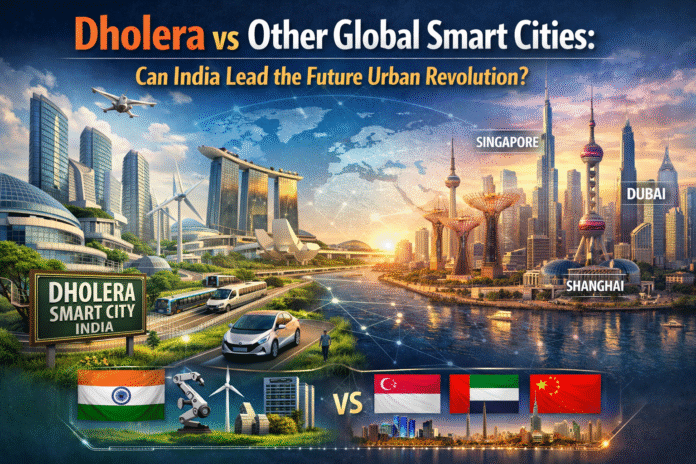
Urbanization is accelerating at an unprecedented rate. According to global forecasts, over two‑thirds of the world’s population is expected to live in cities by 2050. Governments and planners are racing to build cities that are sustainable, inclusive, and technologically advanced — broadly termed smart cities. In this landscape, India’s Dholera Smart City has emerged as a flagship project that could redefine how cities of the future are planned and built.
But how does Dholera compare to other global smart cities like Songdo (South Korea), Masdar City (UAE), Barcelona (Spain), and Singapore? And more importantly — can India lead the future urban revolution? Let’s explore.
📌 Table of Contents
- What Is a Smart City?
- The Rise of Global Smart Cities – A Quick Overview
- Dholera Smart City: India’s Ambitious Urban Vision
- Songdo: The World’s Most Connected Smart City
- Masdar City: Sustainability at Its Core
- Barcelona: Citizen‑Centric Smart Innovation
- Singapore: A Smart City of the Future
- Dholera vs Others: Strengths and Challenges
- Can India Lead the Global Urban Revolution?
- Conclusion
1. What Is a Smart City?
A smart city uses data, technology, and intelligent infrastructure to improve quality of life, reduce environmental impact, and optimize public services. Core components typically include:
- Connected infrastructure (IoT sensors, smart grids)
- Data‑driven governance
- E‑services and digital platforms
- Sustainable planning (green energy, waste management)
- Citizen engagement
Smart cities address the three E’s of modern urban life: Efficiency, Environment, and Equity.
2. The Rise of Global Smart Cities – A Quick Overview
Smart city development is not limited to one region — it is a global movement. From Asia to Europe to the Middle East and the Americas, cities are transforming using technology and design thinking.
Some notable examples include:
- Songdo (South Korea): Entirely built from scratch as a smart, green city
- Masdar City (UAE): Designed for sustainability and zero carbon ambitions
- Barcelona (Spain): Uses smart tech to enhance everyday urban life
- Singapore: A regional leader in urban innovation
Each of these exemplifies unique strengths, and each offers lessons for emerging smart cities like Dholera.
3. Dholera Smart City: India’s Ambitious Urban Vision
Dholera Smart City, located in the state of Gujarat, India, is one of the largest greenfield smart city projects in the world. Planned under India’s Smart Cities Mission, Dholera is designed to be a future‑ready metropolis with world‑class infrastructure.
Key features of Dholera include:
- Integrated transport systems
- Smart utilities (water, power, waste)
- Digital governance platforms
- Industrial and commercial hubs
- High‑quality residential zones
- Green energy and sustainability initiatives
- Ease of doing business
Dholera’s International Airport, Special Economic Zone (SEZ), and dedicated freight corridor connectivity further position it as an economic powerhouse capable of attracting global investment.
Being a greenfield city (built from the ground up), Dholera is a rare opportunity for planners to implement smart technologies without legacy infrastructure constraints.
4. Songdo: The World’s Most Connected Smart City
Songdo, near Incheon, South Korea, is widely considered the gold standard for smart cities. Built on reclaimed land, Songdo was designed as a ubiquitous city, where digital connectivity is embedded everywhere.
🍃 Core Features of Songdo:
- Centralized Data Centers managing traffic, waste, and utilities
- Pneumatic Waste Collection System (source‑to‑processor waste transport)
- Sensor‑based infrastructure for energy, transport, and security
- Sustainable architecture and green spaces
Songdo’s success lies in its data‑first philosophy — where information flows seamlessly and drives efficiencies. The city feels futuristic due to its early adoption of smart systems.
Limitations:
Despite its advanced tech, Songdo has struggled with population density and community vibrancy, highlighting that technology alone doesn’t create livability.
5. Masdar City: Sustainability at Its Core
Located in Abu Dhabi, UAE, Masdar City was envisioned (and largely still is) as a zero‑carbon, zero‑waste city.
🌱 Masdar’s Smart City Highlights:
- Renewable energy systems (solar, wind)
- Sustainable architecture and passive cooling designs
- Electric public transport
- High‑efficiency water systems
Masdar’s emphasis is not just smart technology, but environmental stewardship. It is a case study in how urban development can coexist with strict ecological goals.
Challenges:
Progress has been slower than anticipated due to high costs and technological constraints, but Masdar remains a global benchmark for sustainability.
6. Barcelona: Citizen‑Centric Smart Innovation
Unlike planned cities like Songdo or Masdar, Barcelona took an existing medieval city and transformed it through smart solutions.
🌆 Barcelona’s Smart Strategies:
- Smart street lighting and waste management
- e‑services for citizens (transport, health, governance)
- Citizen data platforms
- Public‑private tech partnerships
Barcelona demonstrates that smart cities can emerge from evolution, not just design. Its approach proves that community involvement and accessibility matter as much as technology.
7. Singapore: A Smart City of the Future
Singapore is often described as the world’s largest living smart lab. With high digital adoption, excellent urban planning, and a forward‑thinking government, Singapore blends technology with policy.
🌐 Singapore’s Smart City Blueprint:
- Predictive analytics for traffic and energy use
- Smart homes and public spaces
- e‑government services with high user adoption
- Safety & surveillance innovations
- Green building codes
Singapore’s success stems from effective governance, strong institutions, and a unified vision. It is both a smart city and a smart nation.
8. Dholera vs Other Smart Cities: Strengths and Challenges
Now that we’ve explored global examples, where does Dholera Smart City stand?
✅ Key Strengths of Dholera
✔ Future‑ready infrastructure
Unlike retrofit smart cities (e.g., Barcelona), Dholera has the advantage of being built with integrated technologies from the start.
✔ Economic Anchors
With its SEZ, connectivity to freight corridors, and proximity to major industrial hubs, Dholera is designed as a global business gateway.
✔ Government Support & Policy Clarity
India’s Smart Cities Mission and policies around ease of doing business create a favorable regulatory ecosystem.
✔ Scale and Scope
At thousands of square kilometers, Dholera is one of the largest planned smart cities globally.
⚠ Challenges Ahead
✘ Implementation Speed
All planned cities face delays — ensuring infrastructure rolls out on time is critical.
✘ Adoption of Technology
Deploying smart tech is one thing; ensuring people use it and benefit from it is another.
✘ Urban Culture & Community
Technology doesn’t guarantee vibrant city life — community, arts, and lifestyle also matter.
✘ Environmental & Social Challenges
Balancing growth with ecology and equity remains a priority.
9. Can India Lead the Global Urban Revolution?
🌍 The Case for India
India is urbanizing faster than many countries — adding millions to its cities every year. This presents a unique opportunity to build smart, resilient, and sustainable urban centers.
Here’s why India could lead:
1. Demographic Advantage
India has one of the world’s youngest populations. Youth are more likely to adopt digital solutions and new urban lifestyles — a major force in smart city adoption.
2. Policy Push
Programs like:
- Smart Cities Mission
- Urban Rejuvenation initiatives
- Digital India Program
…signal that India prioritizes urban transformation.
3. Technological Talent
India has a massive talent pool in IT, data analytics, and engineering — the backbone of smart city development.
4. Growing Startup Ecosystem
From mobility tech to sustainability solutions, India’s startup ecosystem is booming and can fuel smart city innovations.
5. Cost Advantage
Compared to many Western and Middle Eastern smart city projects, India can build at a more scalable and cost‑effective pace.
10. Conclusion: India’s Smart Horizon
In the global comparison of Dholera vs other smart cities, Dholera stands out for its:
✅ Strategic economic positioning
✅ Large scale and long‑term vision
✅ Integrated planning and governance
✅ Growth potential
However, success will be measured not just by infrastructure, but by livability, sustainability, inclusiveness, and adaptability.
India has all the ingredients to lead the future urban revolution — but leadership will depend on execution, innovation, and a citizen‑centric approach. If Dholera can successfully marry technology with human needs, it could become a global smart city model — rivaling Songdo, Singapore, and Barcelona.
The future of cities is smart, sustainable, and human. With the right strategy, India could be at the heart of that transformation.

