
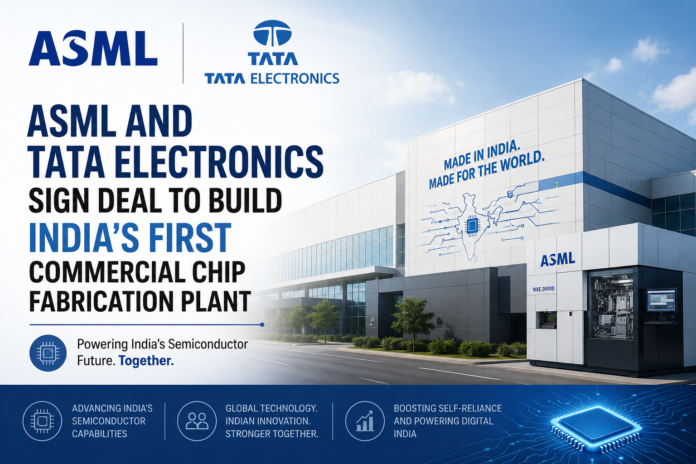
India’s semiconductor ambitions have taken a major leap forward as ASML and Tata Electronics move closer to powering the country’s first commercial semiconductor fabrication ecosystem. The development is being seen as a game-changing milestone for India’s tech manufacturing future and could significantly boost the growth of regions like Dholera, which is rapidly emerging as a global industrial and semiconductor hub.
India’s Semiconductor Dream Is Becoming Reality
For years, India has relied heavily on imported semiconductor chips for smartphones, automobiles, telecom equipment, defense systems, and consumer electronics. Now, with Tata Electronics partnering with ASML — one of the world’s most critical semiconductor technology companies — India is finally moving toward building a self-reliant chip manufacturing ecosystem.
ASML, headquartered in the Netherlands, is globally known for supplying advanced lithography machines used by leading chipmakers such as TSMC, Intel, and Samsung. These machines are considered the backbone of modern semiconductor fabrication.
The collaboration between Tata Electronics and ASML signals that India is no longer just focusing on chip assembly or packaging but is entering the high-value semiconductor manufacturing space.
Why This Deal Matters for India
The semiconductor industry powers nearly every modern technology product. From AI servers and electric vehicles to smartphones and defense systems, chips are the foundation of the digital economy.
This partnership could help India:
- Reduce dependency on imported semiconductor chips
- Strengthen national supply chain security
- Attract global electronics manufacturers
- Generate thousands of high-skilled jobs
- Position India as a global semiconductor manufacturing destination
The Indian government has also been aggressively supporting semiconductor investments through incentives and infrastructure support under the India Semiconductor Mission.
Dholera’s Growing Importance in India’s Chip Ecosystem
One of the biggest beneficiaries of India’s semiconductor push is expected to be Dholera.
The Dholera Special Investment Region (DSIR) has already gained international attention due to its world-class industrial infrastructure, planned smart city development, and proximity to major logistics corridors.
Dholera is increasingly becoming associated with:
- Semiconductor manufacturing
- Electronics production
- Advanced industrial zones
- Smart infrastructure projects
- Green energy initiatives
With multiple semiconductor-related announcements already linked to Gujarat, experts believe Dholera could evolve into India’s semiconductor capital over the next decade.
Tata Electronics’ Big Semiconductor Vision
Tata Electronics has been rapidly expanding its electronics and semiconductor ambitions. The company has already invested heavily in electronics manufacturing and semiconductor assembly operations in India.
The partnership with ASML is expected to provide Tata access to cutting-edge semiconductor manufacturing technologies and expertise, which are essential for establishing a world-class fabrication ecosystem.
Industry analysts believe this move could place Tata Electronics among the most influential players in India’s emerging semiconductor industry.
What Role Does ASML Play?
ASML is one of the most strategically important companies in the world semiconductor supply chain.
Its lithography systems are used to manufacture advanced chips that power:
- Artificial Intelligence systems
- Smartphones
- Cloud computing infrastructure
- Electric vehicles
- Defense technology
- High-performance computing
Without ASML’s technology, producing advanced semiconductors at scale becomes nearly impossible.
The collaboration therefore represents a major vote of confidence in India’s semiconductor manufacturing potential.
Economic Impact and Job Creation
The semiconductor industry is known for generating high-value employment opportunities across engineering, manufacturing, R&D, logistics, and infrastructure sectors.
The long-term impact of semiconductor manufacturing growth in India could include:
- Thousands of direct engineering jobs
- Massive indirect employment opportunities
- Growth of supplier ecosystems
- Increased foreign investment
- Boost to India’s export economy
For regions like Dholera, this could accelerate urban development, housing demand, commercial infrastructure, and industrial expansion.
Global Companies Are Watching India Closely
India’s semiconductor push comes at a time when global companies are actively diversifying supply chains beyond traditional manufacturing hubs.
Factors attracting semiconductor investments to India include:
- Government incentives
- Large domestic electronics market
- Skilled engineering workforce
- Strategic geopolitical positioning
- Rapid infrastructure development
The ASML-Tata partnership further strengthens India’s credibility in the global semiconductor race.
Future of Semiconductor Manufacturing in Dholera
As infrastructure projects continue progressing in Dholera, many experts believe the city could become one of the most important industrial zones in Asia.
With semiconductor manufacturing requiring:
- Stable power supply
- Advanced water infrastructure
- Smart logistics
- Large industrial land parcels
- High-tech ecosystem support
Dholera’s planned smart city model makes it uniquely positioned for long-term semiconductor growth.
Final Thoughts
The partnership between ASML and Tata Electronics represents far more than just a business agreement — it symbolizes India’s growing ambition to become a global technology manufacturing powerhouse.
For Dholera, this is another strong signal that the region could play a central role in India’s semiconductor revolution in the coming years.
As chip manufacturing investments continue flowing into India, Dholera is steadily transforming from a planned smart city into one of the country’s most strategically important industrial destinations.

