
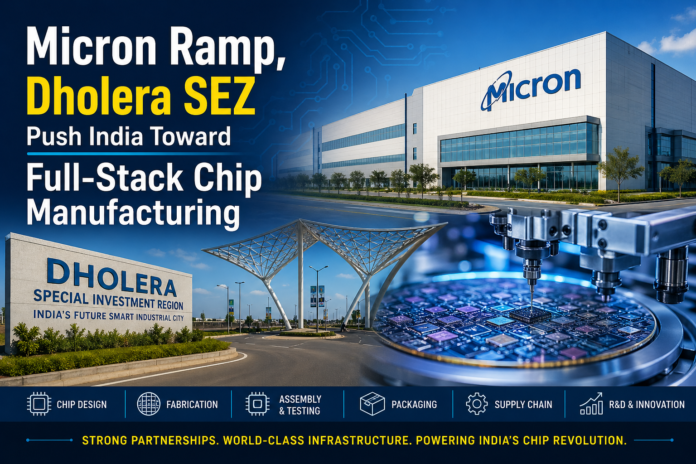
India is rapidly moving closer to becoming a global semiconductor powerhouse, and two major developments are leading the transformation — the expansion of Micron Technology’s semiconductor project and the strategic growth of Dholera Special Investment Region (Dholera SEZ) in Gujarat. Together, these milestones are pushing India toward full-stack chip manufacturing, a goal that could redefine the country’s industrial future.
For years, India has been known for software and IT services. Now, with strong policy support, world-class infrastructure, and global partnerships, the country is stepping into the highly valuable semiconductor manufacturing ecosystem.
What Is Full-Stack Chip Manufacturing?
Full-stack chip manufacturing means having the ability to manage the complete semiconductor value chain within one country. This includes:
- Chip design
- Wafer fabrication
- Assembly, testing, marking, and packaging (ATMP)
- Supply chain support
- Research and development
- Logistics and exports
At present, many countries specialize in only one or two parts of this chain. India’s aim is to build capabilities across all levels, making it less dependent on imports and more competitive globally.
Micron’s Expansion: A Big Win for India
Global semiconductor giant Micron Technology announced a major investment in Gujarat to establish an advanced semiconductor assembly and testing facility. This project is one of the largest foreign investments in India’s chip sector and signals growing confidence in the country’s manufacturing ecosystem.
Micron’s plant will focus on:
- Memory chip assembly
- Testing and packaging
- High-tech manufacturing jobs
- Skill development for Indian talent
- Boosting semiconductor exports
The project is expected to create thousands of direct and indirect jobs while attracting suppliers and related industries.
Why Dholera SEZ Is the Perfect Location
The Dholera Special Investment Region is emerging as India’s most ambitious industrial smart city. Located in Gujarat, Dholera offers everything semiconductor manufacturers need:
1. Plug-and-Play Infrastructure
Dholera is being developed with ready industrial land, internal roads, underground utilities, and reliable power systems.
2. Strong Connectivity
The region is connected through highways, ports, airports, and freight corridors, making exports easier and faster.
3. Government Support
Both the Gujarat government and the Government of India are actively promoting semiconductor manufacturing through incentives and policy support.
4. Smart City Ecosystem
Unlike traditional industrial zones, Dholera is planned as a future-ready city with digital infrastructure, sustainability features, and urban planning.
How This Helps India Become a Semiconductor Hub
The combination of Micron’s investment and Dholera’s infrastructure creates a strong foundation for India’s semiconductor ambitions.
Job Creation
Thousands of skilled jobs in engineering, operations, logistics, and research are expected.
Technology Transfer
Global companies bring advanced manufacturing practices, improving domestic expertise.
Supply Chain Development
Packaging units, chemical suppliers, equipment makers, and logistics providers are likely to follow.
Reduced Import Dependence
India currently imports a large share of semiconductor products. Domestic production can reduce vulnerability to global disruptions.
Gujarat Leading India’s Semiconductor Race
Gujarat has become a preferred destination for semiconductor investments due to proactive governance, industrial readiness, and land availability. With Dholera SEZ at the center, the state is now positioned to lead India’s chip revolution.
Challenges Ahead
While progress is strong, India still needs to strengthen:
- Skilled semiconductor workforce
- Advanced fabrication capabilities
- Water and power reliability at scale
- Long-term R&D ecosystem
- Global supply chain competitiveness
However, current momentum suggests these challenges are being addressed step by step.
Future Outlook
As Micron ramps up operations and Dholera SEZ continues to attract global manufacturers, India is moving from being a chip consumer to a chip producer. This shift can create a new era of industrial growth, exports, innovation, and economic resilience.
For Dholera, this means more than just factories — it means becoming the center of India’s next technological revolution.
Conclusion
The Micron ramp-up and Dholera SEZ push are not isolated developments. They represent a larger national strategy to establish India as a full-stack semiconductor manufacturing destination. If execution continues at the current pace, Dholera could soon become one of Asia’s most important chip manufacturing zones.
For readers of dholeradaily.com, this is a story worth watching closely — because the future of India’s semiconductor industry may well be rising from Dholera.

